
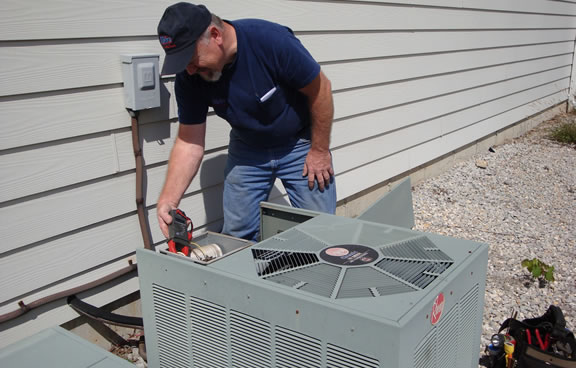
Quick answer: Most Chandler AC breakdowns between June and September come from a small set of parts: capacitors, contactors, condenser fan motors, clogged condensate drains and refrigerant leaks. A technician can usually find the cause in one visit and quote the repair before starting work.
Chandler’s average July afternoon reaches 106°F, and the city has recorded 119°F. An air conditioner here does not get a gentle season. It runs almost nonstop for five months, which is why most of our repair calls arrive between June and September and why small faults turn into no-cool calls quickly.
Why Chandler systems fail when they do
Chandler grew from about 29,700 residents in 1980 to more than 176,000 by 2000. Most homes were built in that window, so a large share of the city’s original equipment has already been replaced once, and many of those replacements are now 12 to 20 years old. Second-generation systems are where we see the familiar heat-season failures:
- Capacitors that swell and lose capacity after repeated 110°F afternoons on a sun-baked roof or slab.
- Contactors with pitted points that keep the outdoor unit humming without starting.
- Condenser fan motors that overheat after years of dust from fields and construction along the Loop 202 corridor.
- Clogged condensate drains in attic air handlers, which can shut a system off on a safety switch or drip through a ceiling.
- Refrigerant leaks at coil joints and line sets, common on older two-story homes with long refrigerant runs.
What happens on a repair visit
A technician confirms the complaint at the thermostat, checks the breaker and disconnect, then tests the outdoor unit under power: voltage, amperage draw, capacitor readings and pressures. Indoors we look at the filter, blower, coil and drain line. You get a plain explanation of what failed, the repair price before any work, and an honest note if the system’s age makes the repair a poor investment.
Repair or replace?
Our rule of thumb for Chandler homes: if the system is under about 12 years old and the failure is a part (capacitor, motor, contactor, drain), repair it. If the compressor has failed, the coil is leaking on an older unit, or you have paid for several major repairs in two summers, it is worth pricing a replacement before spending more. Our AC replacement page explains what that involves in Chandler.
Chandler specifics worth knowing
Chandler’s Development Services department handles building permits from 215 E. Buffalo St. The city’s Homeowner’s Building Permit Manual (revised April 2026) exempts like-for-like swaps of water heaters, furnaces and evaporative coolers, but it does not list air conditioners or heat pumps as exempt. If you are unsure whether your job needs a permit, the city’s Plan Reviewer of the Day takes questions at 480-782-3078. We pull the permit when one is required, and we tell you before work starts.
Parts of Chandler are served by SRP and parts by APS, so if a repair turns into a replacement, the rebates available depend on which utility bills you.
Quick checks before you call
- Set the thermostat to cool and at least 3°F below room temperature.
- Replace a dirty filter.
- Reset a tripped breaker once. If it trips again, leave it off and call.
- Look for water in the drain pan or a float switch that has shut the system off.
Common questions
How fast can an AC be repaired in Chandler?
Most part failures, such as a capacitor, contactor or fan motor, are fixed the same visit. Compressor or coil failures take longer and often lead to a repair-or-replace decision.
Is it worth repairing an AC that is 15 years old?
If the failure is a small part, usually yes. If the compressor has failed or the coil is leaking on an older system, pricing a replacement first is the better move.
Why does my AC stop cooling in the afternoon?
Chandler's average July high is 106°F. A system that is low on refrigerant, has a dirty outdoor coil or is undersized falls behind at the hottest part of the day.
No cool air in Chandler? Call 480-719-8109 — a real person in the East Valley answers.